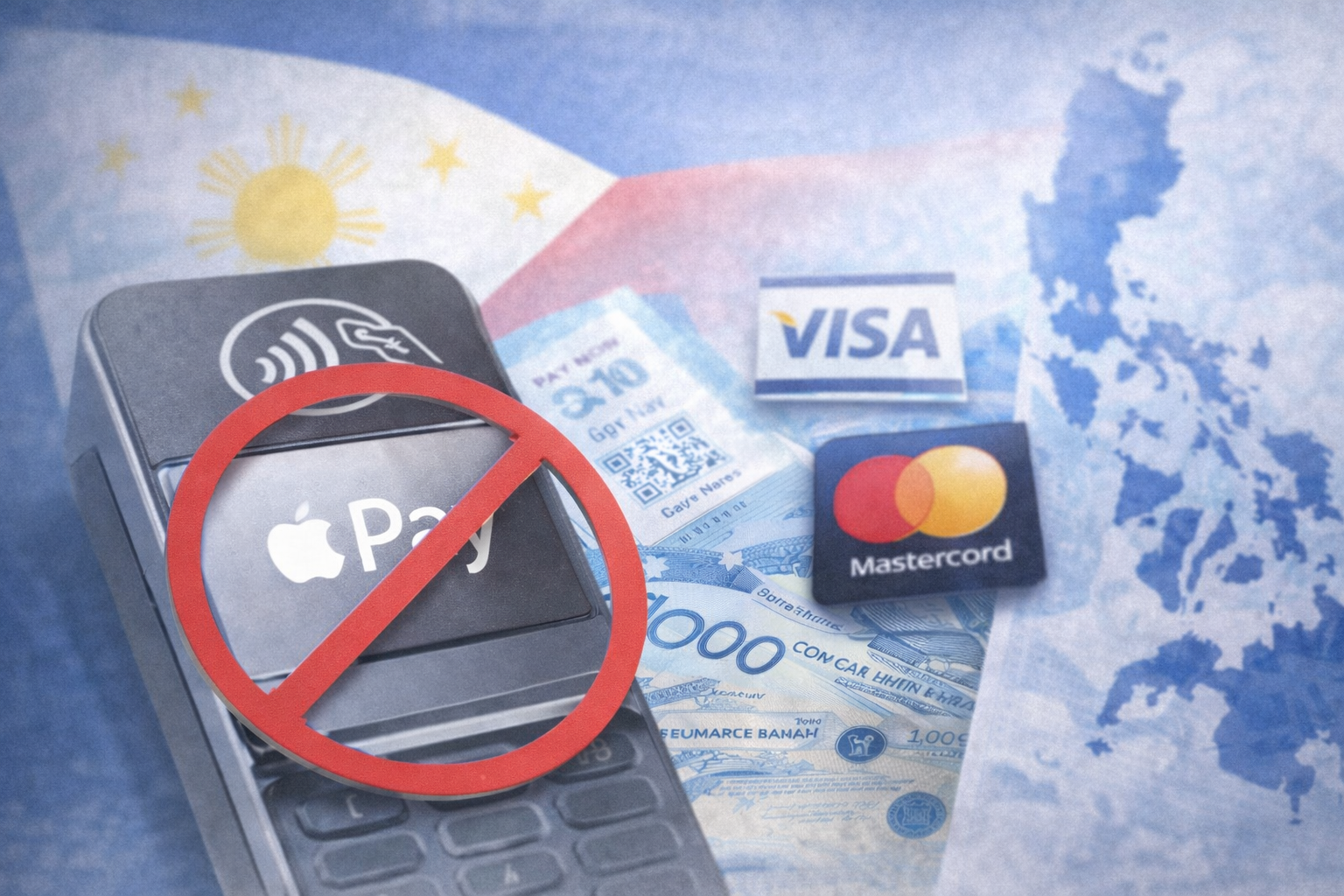
For many foreigners living in the Philippines, the first surprise comes quickly. You pull out your iPhone at a café or store, double-tap the side button, and nothing happens. No Apple Pay. No familiar tap-to-pay experience. Just a cashier waiting for cash, a QR code, or a local app you have never used before.
The immediate question is obvious: why does Apple Pay still not work in the Philippines, when it works in so many other countries?
The real answer is more complex than “Apple hasn’t launched it yet.” Apple Pay’s absence is the result of how the Philippine payment ecosystem evolved, how local banks operate, and how Visa and Mastercard’s role in the country differs from what many foreigners expect.
Apple Pay depends on more than Apple
Apple Pay is not just a software feature. It is a three-way agreement between Apple, card networks like Visa and Mastercard, and local issuing banks. Apple provides the platform and the secure wallet. Visa and Mastercard provide the card rails. Local banks must integrate their systems, assume liability, and support tokenized payments.
In the Philippines, this triangle has never fully aligned.
Local banks move slower than the technology
One of the biggest factors is that Philippine banks have historically been conservative with consumer payment innovation. Many banks still rely heavily on traditional card transactions and online banking systems that were not built with mobile wallets in mind.
Supporting Apple Pay requires banks to upgrade infrastructure, accept new security models, and share part of the transaction economics. For many local banks, the incentive simply has not been strong enough.
The role of Visa and Mastercard in the Philippines
Many foreigners assume that because Visa and Mastercard are widely accepted in the Philippines, Apple Pay should automatically work. In practice, card acceptance and mobile wallet integration are very different things.
Card networks do not control local launches
Visa and Mastercard enable Apple Pay technically, but they do not force banks to support it. In countries where Apple Pay launched quickly, banks saw a clear benefit: reduced fraud, higher card usage, and pressure from consumers.
In the Philippines, card usage patterns are different. Credit card penetration is lower, many transactions are cash-based, and mobile payments evolved along a separate path.
Visa and Mastercard followed the market, not the other way around
Instead of Apple Pay driving mobile payments, the Philippine market developed its own solutions first. QR-based systems, mobile wallets, and direct transfers became dominant long before Apple Pay was a realistic option.
Visa and Mastercard adapted to that reality rather than reshaping it.
Why local mobile wallets changed everything
The most important reason Apple Pay feels “late” in the Philippines is that it arrived in a market that already solved the problem differently.
GCash and Maya filled the gap early
Local wallets like GCash and Maya grew rapidly because they addressed real limitations in the banking system. They worked without credit cards, supported peer-to-peer transfers, and integrated easily with daily life. Over time, they became the default payment method for millions of people.
Once these systems were entrenched, the demand for Apple Pay weakened. For most locals, Apple Pay was not a missing feature. It was an unnecessary alternative.
Apple Pay does not replace local wallets
Apple Pay is designed primarily as a card-based wallet. In the Philippines, the dominant payment model is account-to-account and QR-based. This mismatch reduced urgency for banks and regulators to push Apple Pay forward. For foreigners, this often leads to an important question: if Apple Pay doesn’t work in the Philippines, how safe are the local alternatives? One of the most common concerns is whether mobile wallets like GCash can actually be trusted for daily use.
Regulatory and compliance considerations
Another factor often overlooked is regulation. The Bangko Sentral ng Pilipinas (BSP) has encouraged digital payments, but with a strong focus on local interoperability and financial inclusion.
Apple Pay’s model is global and bank-centric. Philippine regulators prioritized systems that:
- work without international cards
- support local identity frameworks
- integrate directly with domestic payment rails
This does not block Apple Pay explicitly, but it lowers its priority.
Why Apple Pay sometimes “almost” works
Some foreigners report seeing Apple Pay terminals or contactless readers and assume Apple Pay should work. In reality, many terminals support NFC for cards, not for mobile wallets.
Apple Pay requires backend support from issuing banks. Without that support, the terminal alone is not enough.
What this means for foreigners living in the Philippines
For foreigners, the absence of Apple Pay feels like a step backward. It breaks habits formed in other countries and forces adaptation. But it is not a sign that the Philippine system is broken. It is a sign that it evolved in a different direction.
Understanding this helps avoid frustration. Apple Pay is not missing because the Philippines is behind. It is missing because local solutions became dominant first.
Will Apple Pay ever launch in the Philippines?
It is possible, but it is not guaranteed, and it will not be driven by Apple alone. A launch would require:
- multiple major banks committing simultaneously
- clear regulatory alignment
- enough consumer demand to justify the investment
Until then, Apple Pay remains a secondary concern in a market that already moved on.
How foreigners should adapt instead
Rather than waiting for Apple Pay, foreigners living in the Philippines are better served by understanding and using local payment systems responsibly. This includes knowing when to use cards, when to rely on mobile wallets, and when cash is still unavoidable.
Apple Pay’s absence is inconvenient, but it is not a dead end. It is simply part of learning how daily systems work differently in the Philippines.
Final thoughts
Apple Pay’s lack of availability in the Philippines is not the result of a single delay or decision. It is the outcome of how Visa, Mastercard, local banks, regulators, and consumers interacted over time. Local wallets solved problems faster than global platforms could adapt.
For foreigners, the key is not waiting for familiar tools to arrive, but understanding why they did not—and what replaced them instead. That understanding makes daily life smoother and avoids unnecessary frustration.